How a coin is made: the curve, graduation and the pool
How a new coin comes to exist, what a bonding curve does to its price, and why progress, completion and migration are three separate events.
 Trenches8 min read
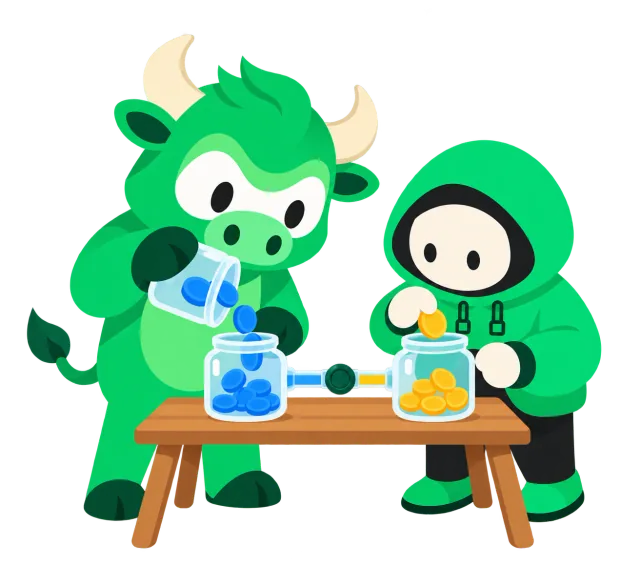
Where does a new memecoin come from, and what happens to it after launch? After reading this page, you can explain how a bonding curve sets a price, why the mint address is the coin, and what graduating really means.
Anyone can launch a coin
Most memecoins trade on Solana, a network that runs on its own coin, SOL. On pump.fun, a new coin, also called a token, first sells on a bonding curve, a pricing rule explained below.
That makes pump.fun a launch service: a program (code on Solana) and an app. Together they let anyone create a coin and sell it on a curve, under stated rules and fees. As Three parties in a launch puts it, a launch is an event that happened, not a sign that anyone checked or approved the coin.
Three parties take part: the service, the traders who buy and sell on the curve, and the creator. The creator is just the address that sent the request to make the coin: a public string of letters and numbers. It does not tell you who the person is, so a post saying "I made this coin" stays a claim. A message signed from that address could support it, since only its controller can sign one (The creator address).
Every curve trade also pays fees, listed in the service's fee schedule. In the lesson's made-up schedule, each trade pays 1 percent to the service and 0.25 percent to the creator address, on sells as well as buys (The fee schedule).
So the creator earns on trades it never made. A big fee total tells you a lot was traded, not that the price went up (Fees across volume). Real pump.fun fees differ and can change, so Fees beside the curve says to read the current ones.
What is a mint address?
A coin's mint is the record on Solana that defines it and counts its supply, the number of units that exist (Minting changes supply and one holder balance). Its address, the mint address, is the coin's identity. It stays the same on the curve and in any later pool.
When pump.fun creates a coin, one transaction sets up its mint, a record for its curve and a record for its name and picture. It makes no pool (The create transaction).
The name, the ticker (the coin's short label) and the picture are metadata: display details the creator chose. Anyone can copy all three, and on pump.fun many coins often share a hot ticker (A ticker is a label anyone can choose).
A lookalike address shares the first and last characters of the real one, which is all a shortened address shows (Lookalike addresses). Say the real mint is PF4xR7731Kq9aZq and a copy is PF4xR2208Kq9aZq. Cut to their ends, both read PF4x...9aZq.
So compare the full mint address with the one the project publishes in its own channel (The mint is the identity). Spotting scams and low-quality tokens covers copies in full.
What is a bonding curve?
A bonding curve sets a coin's price from how much of it has sold. As the app's dictionary puts it, "Each buy moves the price up the curve, and each sell moves it back."
Easy to mix up: a curve and a pool. A pool is a pair of token reserves that a program swaps between. Each reserve is an amount of one coin, such as SOL or the new coin, put in by people called providers. On a curve, no providers supply the tokens: the launch program sells them, and buyers pay in SOL (What a bonding curve is).
pump.fun's curve follows a constant product on virtual reserves (The model pump.fun declares). Its two reserves, SOL and tokens, multiplied together stay the same across each trade, before fees.
Say a curve's formula starts at 30 SOL and 1,200,000 tokens, far fewer tokens than real pump.fun curves use. Multiplied, they make 36,000,000. The price for the next tiny buy is 1,200,000 divided by 30: 40,000 tokens per SOL. Fewer tokens per SOL means a higher price.
Those starting reserves are virtual: only the formula uses them. At the start, the curve really holds no SOL and 800,000 tokens, and only what it holds can be paid out. So however big your buy, no quote, the estimate shown before a buy, can promise more than 800,000 tokens (Real tokens set a ceiling).
Now say you spend 10 SOL, fees aside. The formula then counts 40 SOL, so it keeps only 900,000 tokens (36,000,000 divided by 40). You get the other 300,000, not the 400,000 the starting price suggests. Each bit of your buy met a worse price than the bit before (Not the starting price).
If you had spent 20 SOL instead, from the same start, you would get 480,000 tokens: more in total, but 24,000 per SOL against 30,000 for the 10 SOL buy (Comparing the two buys). That gap below the starting price is your buy's own price impact, which Why a coin has a price, and why thin coins slip explains.
The first buyer can be the creator. In The first transaction, the creator's address buys part of the supply inside the transaction that creates the coin, before any outside buyer could see it. Every later buyer pays a price that buy already moved. That alone proves no bad intent: it only tells you who bought first.
Early on, the curve is thin: it holds little SOL, so one modest buy can move the price far. That is one buyer meeting a thin curve, not a crowd of buyers (A thin early curve).
What does graduating really mean?
Graduating sounds like one step, but people mix three things into it: progress, completion and migration. Progress is the bar on a launch page. pump.fun defines it as the real tokens sold, divided by the real tokens the curve started with (What the bar shows). It is not a chance of completing, or of profit (Not a probability).
The bar moves only with trades: buys push it up, and sells push it down, because a sell puts tokens back (Progress can fall). Say a curve started with 800,000 real tokens and 512,000 have sold: the bar reads 64 percent. Then someone sells 32,000 back, so 480,000 count as sold, and the bar drops to 60 percent.
Completion is the moment the sale ends. pump.fun's graduation condition, its rule for a finished curve, is that no real tokens are left to sell (Progress is not completion).
Migration is a separate transaction. It moves the curve's liquidity into a pool: the SOL it raised, plus tokens the launch rules set aside for that pool. The mint stays the same. Completion moves nothing by itself: someone has to send the migration, and an attempt can fail.
Between completion and a confirmed migration, you cannot buy or sell the coin on pump.fun (The waiting time). In the lesson, a curve completes at 16:20:05, a first migration attempt fails, and a second is confirmed at 16:24:15. For about four minutes, holders can only wait. On pump.fun today the wait is often short, but not always.
People use graduated for completion, for migration or both (What counts as graduating). A page can say Migrating before any migration was sent (Completion first), and a same-named pool for a different coin can open first (A copycat with the same name). The real one, the canonical pool, is the one the launch's own migration created, and it trades the original mint (What makes a pool canonical).
Graduation promises no price rise. Progress is not graduation tests a post claiming a double at graduation, and the data backs none of it. Later in that unit, the pool's price falls after migration, and each buyer's result depends on the price they paid. A page of graduates lists only the coins that made it, so it cannot tell you how often launches complete (Survivors on display).
New, Soon and Graduated on the Trenches board
The Trenches board sorts launches into three lists: tabs on a phone, columns on a computer. Each column has a note in the app's own words:
- New: "Launched under 6 hours ago, newest first"
- Soon, called Final Stretch on a computer: "On the bonding curve at 25% or more and traded in the last 45 minutes, nearest to migrating first"
- Graduated, called Migrated on a computer: "Filled the curve and moved to a trading pool, newest migration first"
So on Trenches, Graduated means migrated.
If your country allows it and you pick Solana on the board, its header adds one line: "pump.fun coins here trade on pump.fun." Most new coins go to zero. Trade only what you can lose.
Read the board the way What the feed shows reads any launch feed: a filtered, delayed list from the sources the app covers. A row's place follows its column's sort, not merit. Seeing a coin early is not the same as gaining from it (The top row).
Paper trading a launch on Trenches costs only practice money. On a computer, a row shows its address cut to its ends, the part a lookalike copies. So take the full mint from the row's copy button. Once the coin migrates, check that the pool's page shows the same full mint address.
Then write a launch card, a short note of the service, the mint, the creator address and the fees, plus one line on what it cannot prove.
Practice it free
Learn it, then practice it on paper
Seven short units on memecoins, then practice trades on live coins with paper money, before you risk a dollar.
Start the free Memecoin starter Start the free Memecoin starterIn this browser, sign up with email. Google sign in works in Safari or Chrome.